
Hawler
What better routes can change for your business
Route optimization helps you reduce avoidable driving, use available vehicle hours and prepare a clearer plan for customers and staff. Its value comes from what changes in your operation. Here is what to look for and how to measure it.
Lower the cost of avoidable kilometres
A better stop sequence can reduce backtracking and repeated journeys. To estimate the fuel effect, multiply kilometres avoided by your vehicle's litres per 100 km, divide by 100 and multiply by the price per litre. For illustration, 30 fewer kilometres at 9 L/100 km and EUR 1.60/L would save EUR 4.32 in fuel that day. This is arithmetic, not a measured Hawler customer result.
Find capacity before adding another vehicle
Planning all available vehicles together can reveal spare time hidden in uneven routes. Shorter travel may make room for another delivery or customer visit within the same shift. Compare completed work, vehicle hours and overtime. Use the results to decide whether a busy day needs another vehicle or a better allocation of the existing fleet.
Give customers a clearer arrival estimate
A route that includes travel and time on site gives your team a basis for communicating expected arrivals. Review Hawler's planned ETAs and share them through your usual customer channels. Update customers when the plan changes. Measure arrival reliability and calls asking about arrival times; the planning estimate is not live tracking or an automatic notification.
Respond to changing order volumes
Build the plan around today's demand and available vehicles. On busy days, inspect unassigned stops and overloaded schedules early enough to make a decision. On quieter days, test whether fewer active vehicles can cover the work. Reoptimizing existing stops does not consume more of Hawler's stop allowance, so you can compare plans as circumstances change.
Recover time spent preparing the day
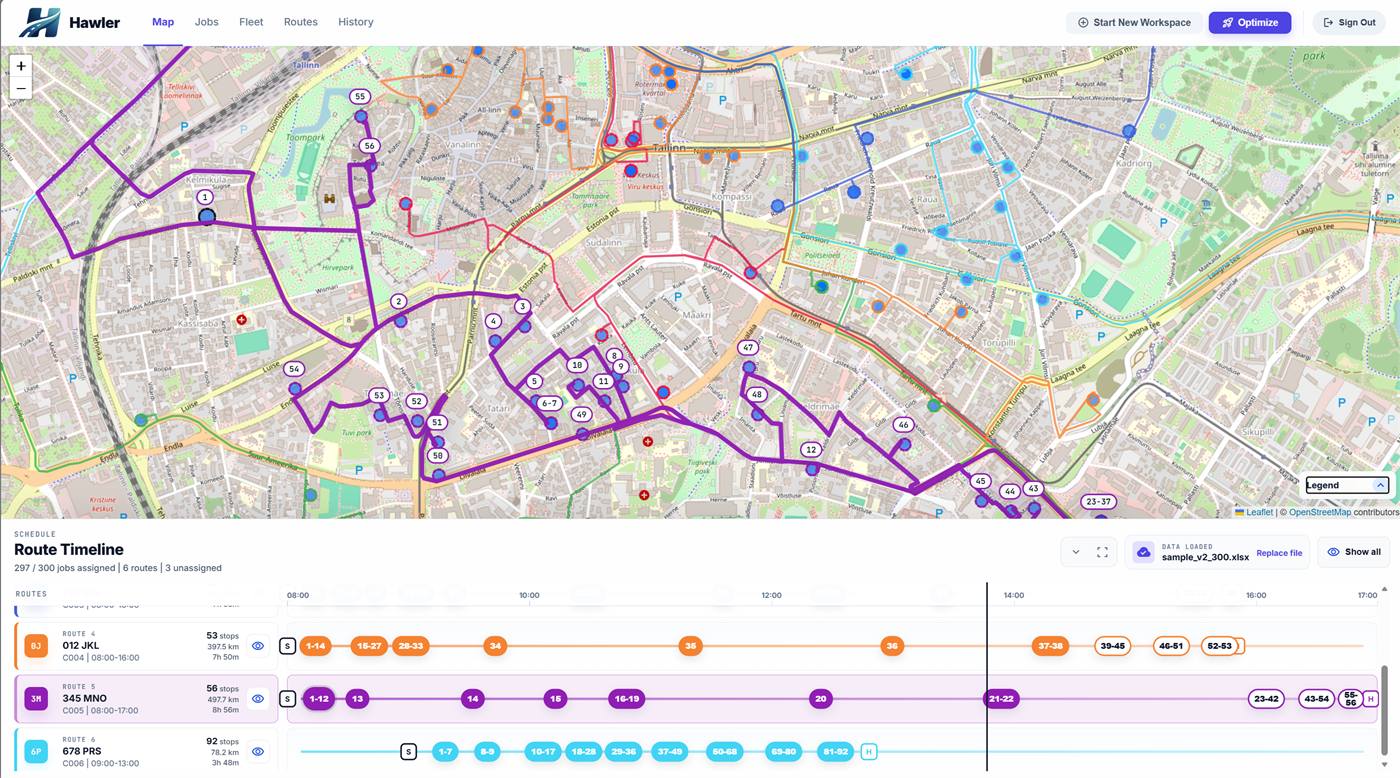
Count the work around route planning too: checking spreadsheets, looking up addresses, assigning stops and preparing route sheets. Hawler brings these tasks into one workflow. Measure the time from receiving a usable order list to handing over a checked route plan. Time released can go into handling exceptions, serving customers and preparing for growth.
Reduce manual address work in the Baltics
Address lists from Lithuania, Latvia and Estonia often contain abbreviations, spelling variations and inconsistent formatting. Hawler matches them using local address data, then flags cases that need attention. Review the locations instead of looking up every row manually. Record time spent correcting addresses and the number needing intervention to assess the benefit on your own lists.
Evaluate one representative week
Save your usual plan, then use the same stops, vehicle availability, capacities and visit durations in Hawler. Compare planned kilometres and preparation time first. During the working day, record actual travel, completed visits and overtime. Repeat on both busy and quiet days. Estimate the monthly value of fuel and time saved, then subtract the software cost; avoid counting the same working hour as both labour savings and extra sales capacity.
Before you plan
Can a small company try route optimization without paying?
Yes. Hawler Starter is a free plan with 1,500 stops created per month, up to 3 vehicles and 5 active users. It includes address validation, route optimization, map review and route-sheet or Excel exports. No payment card is required. Keep using Starter while you remain within its limits.
How much will route optimization save my company?
The useful answer comes from your routes. A team already running short, well-balanced rounds may gain less than one spending hours on manual planning and repeated journeys. Compare a representative week, measure actual results and include the software bill. Hawler's free plan lets a small team make that evaluation with real work.
How does the pricing affect the business case?
Starter has no software subscription cost within its limits. Paid plans include multiple vehicles and users in one base price, instead of a licence fee for every driver. Add any extra-stop charges to your monthly estimate and compare the total with the operating benefit you measured. The pricing section publishes the allowances and rates.
Free Starter plan
A larger monthly allowance than low-volume free alternatives. Run real delivery or service rounds and keep using Starter within its limits.
- 1,500 stops / month
- Up to 3 vehicles
- 5 active users
Planned capabilities
A platform growing with your operation
Development is extending the planning workflow into more detailed scheduling and connected field work. The capabilities below are planned; contact us to discuss availability for your operation.
Time windows, priorities and zones
More detailed scheduling will help teams plan delivery and service rounds around customer time windows, operational priorities and service areas.
Connected driver workflows
The wider platform direction connects planned routes with task lists, status updates and delivery records, so teams can carry their plan through the working day.
Build the plan your business needs
Explore the workflow for your operation, or work through the costs and capacity that better routes can change.
Route planning software
See how Excel import, address review and multi-vehicle optimization fit into one daily workflow.
Logistics route planning
Plan delivery rounds around order quantities, unloading time and the vehicles available today.
Service route planning
Account for time on site and travel between customers when planning your field team's day.
Benefits for your business
Understand the effect on fuel, planning time and customer capacity, then measure it with your own routes.